Hi I am Pratibha

I am an author by choice, speaker by love and marketeer by passion not in that order.I believe behind all B2B systems, behind B2C brands, behind game changing technologies, sits a PERSON thinking, feeling, buying and making decisions. I write on humanizing brands marketing technology and leadership to create value for that thinking feeling buyer. Read on if you are THAT PERSON OR WANT TO REACH HIM/HER.

Saturday, April 11, 2015

Getting to Yes: BUT First YOU need to OPEN your mouth! in 50 seconds

I am running a FREE 30 minutes WEBCAST ON HOW TO MAKE AN ELEVATOR PITCH IN 50 SECONDS on April 15th 11:30 am IST- REGISTER NOW. 

AND HERE is why you should attend it!!

Few months ago I had a massive argument with my Mom. The scene went like this.
Mom: I bought a new string of sapphires.
Me: why, mom isn't I it an invalid expense?
Mom: How can you judge me and choice of expenses? How can you say I am spending on Jewelry? Is this what kids teach you when you are grown up?
After 1 hour of frustrated argumentation. I asked her?
Me: What did I say which made you angry?
Mom: You questioned my choice of spending? You disapproved ME. You must have thought I can spend on gold instead. You must have assumed gold appreciates more. And by the way I don’t even have much Jewelry or care for it or wear it. One purchase which I share with daughter has to bring much comments. Anyway I am retired, how can I afford expensive metals hence I need to settle for beads. I know you will only advise me to save and not think of what I want. You don’t even know how much or how often I spend.
Me: I only said isn't this an invalid expense. You did not allow me to finish.
Mom: You never MEANT all that?
Me: NO!! I will say something If I want to, why will I suggest it?
Mom: But I thought you meant……….

"But I thought you meant.." How familiar does the last statement sound; with spouse, in offices, in business conferences, with children?

I still remember when my mentor asked me to define the word communication.
I said- telling someone to do something.
He stopped me short and said NO, Telling someone what you want them to do and getting a YES in return.
Communication is a  2 way process- not just imparting information. However wonderful YOU are or YOUR products are it just stays in the BOX unless you know how to communicate.

But the FIRST STEP in Communication is TO MAKE a MOVE. TO SPEAK.

But most people don’t know WHAT and HOW TO speak?
Did you know it takes roughly 50 seconds to make a first impression? And roughly 60% more impact depending whether you open your mouth or not in the first meeting?
BUT HOW to say something relevant on the spot? Don’t you go blank? Tongue-tied? A sudden question shot at you in a business conference. A sudden presentation in front of 50 people. A sudden hello to a good-looking guy in a lift? Or explain yourselves when attacked with statements and finding yourselves tongue-tied  in family arguments? Or simply to present yourself against bull dozing team members in group presentation? Do the Talkers take away the mantle when you are a doer?

It is time to change it. I am running a FREE WEBCAST to help you SPEAK UP in 50 seconds- Click here to REGISTER!!

Friday, April 3, 2015

WHY YOUR OWN MIND IS DECEIVING YOUR REALITY!


Friends, I received wonderful response comments from all of you for the post “Managing others perceptions to create your reality”. In fact it has triggered many debates about what is ABSOLUTE reality. While some of my friends spoke about taking FAITH - here. Some spoke of IDENTITY here. What was most amusing was how differently we all perceived the post about perception.
The most interesting comment I received though was that “How others view us or how we view others are all filtered through a set of cognitive biases that invariably deviate quite a bit from rationality and good judgement. “
Wikipedia says, Cognitive bias is a pattern of deviation in judgment, whereby inferences about other people and situations may be drawn in an illogical fashion.
And so in this post I will delve a little deeper into exploring how cognitive bias works for a layman quoting an example from Malcolm Gladwell.
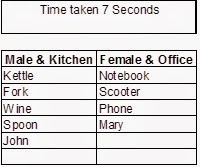
Let us get into a mini exercise.

This was pretty quick and easy. Did your results look like this?

 Let us see what is happening here. When the mind is under time pressure, we BLINK not think. That means we make flash judgement. However in the backdrop of this judgement occurs a data processing within your mind. When you see John, your mind fetches all the instances in which you have comes across the word John. In this case it happens to have been men named John and hence it categorizes John as Male. The categorization happens very fast since there is precise information. When it sees the word kitchen it fetches all instances in which kitchen has been seen, heard, or accessed and in MOST of such instances have been associated with females. Hence it associates the word with FEMALE.  

Now let us make a few changes to this test and try again.


Did you take longer to do this one than the previous test?


Why?
The mind’s data processing has just been introduced to a conflict. Historical data calls John male. But most Johns had never been seen in the kitchen. And so the mind needs to THINK and rationalize. I took 7 seconds to complete this test and this is how my results look like.

These two tests are variations of the Implicit Association Test. In simple terms it means, we have different kinds of biases based on information stored in our brain. These can be more than 100 types of biases. However the specific bias referred here is Stereo type bias, where the mind tends to make decisions based on the stereo type information fed into it.
However what does our experience with two tests tell us?
  1. Our perceptions are formed by the volume of information available to our brains over a period of time.
  2. Perceptions can be broken if we STOP the process of concluding results from the volume of information available. We CAN introduce new ideas to the brain and FORCE it THINK rationally.
Our brain can be forced to think differently fighting past information. It is up to us to enable our minds to think so. And before expecting others to think so, we need to do that ourselves.
A notable point here is that our own minds are susceptible to fall prey to implicit biases. For example: when I took the first test, in spite of me being a working woman who goes to office, I grouped the word “kitchen” under female. WHY? My brain merely processed the massive volume of information fed into it by new channels and historical data. Now in the second test, I stopped myself from auto-grouping “Kettle” under “Female & Office” and FORCED myself to think why can’t a spoon be categorized under Male. Why not desk under female? That is when my mind started changing perceptions and tried to think RATINOALLY.
As woman I want others to view me as a forthright and independent minded person. YET- I realise I have implicit biases within myself. And I sometimes subject myself to fall prey to them. I need to change how I THINK about myself and only then can I change what others think of me. And thus I need to create my own reality and then enable others to see it.
So, what reality are you going to create for yourself today?
References: You can go take the IAT on the internet, read more about it here or refer to the book Blink. 

Monday, March 30, 2015

Can you manage perception to create your reality?


“Perception is reality-Unfortunately our perception is your reality”- said a client director to my sales leader recently in a business discussion.
In a business scenario, our clients hold the purse strings. We need to add value to him/her woo them, please them enough to be convinced to change their perceptions about our products, our business and our brand in order to be associated with us.
But in a personal scenario, do we still do the same? Every single day that we come to work we carry a personal brand. We need to add value to the people we talk to, colleagues, clients, partners, something to take away. If it is a person in higher management or a client, we woo them, sell our image and create our perception in way we want it to be.
In an ideal world, our perception of ourselves should be our reality. But it is not. Usually our reality becomes what others perceive of us irrespective of what we believe in. Ex: Say, I have been working out for 3 months and feel really fit and trim. But when I run into a colleague who says, “Hey long time, looks like you have gained some holiday weight!” AND… blooop… there goes my confidence down the drain.
IT should not.
But it does.
And then we spend time for damage repair and convincing ourselves that what the others thought of us was not real.
Strangely this necessity to want to be perfect to the world shows up differently in different genders. While women show a larger inclination towards being perfect in their looks and also in multitasking (balancing home and work), men seem to show a higher tendency towards being viewed confident and as someone who is in charge of situations.
It is partly true that physical appearance as such plays an important role in image perception. Malcolm Gladwell in this article particularly speaks of why tall men are perceived to be leaders and 58% of CEOs in Fortune 500 companies are taller than 6 feet.
Yet, judgment about appearance has larger impact on female self-esteem than male. Many social experiments have particularly proved that beauty in other women or praise for other women sparks an instant threat in a woman. This is partly genetic and partly deep-rooted in the way women have been perceived time immemorial.
Similarly, the man has been the Alpha provider in tribes right since we evolved from Apes. While the purpose of the female has been to nurture, the man has been to provide and protect. This is again as deep rooted as is the female insecurity for physical appearance.
But why is any of this relevant to personal branding or building our perception? Because in order to build a brand for the world it is important to build a brand for oneself. What we are, we believe becomes our second nature and our reality and thus our perception.
How can then, either gender deal with this insecurity from affecting how they view their own personal image?
Recognize: Awareness and acknowledgement is the first step to action. It is important to recognize that feeling judged for physical appearance is in the genes and second nature of women. It also is an important part of self- identity. This acceptance saves many women the trouble to disprove it, fight and to keep re-defining their image based on what other think. Ex: A few days ago a male friend suggested that my profile picture on facebook looked boring. Ideally I should not be bothered. I actually thought it was very pretty and professional picture in a saree. Neither am I young teenager to feel flustered the moment I am not judged fashionable enough. And also I am as such not very dressy girl. Yet, it bothered me. The fact that a younger woman’s picture was stated as an example bothered me somewhere deep down inside. WHAT bothered me was not the comment but the fact that I was jealous. After deeply pondering over this thought, I have come to acknowledge that this is my nature. I am supposed to feel threatened deep down inside and that it is OK. I do not have necessity to prove that I don’t care, neither do I have a necessity to compete. I feel judged and that is ok. Whew!
For men, acceptance that their female family members would take more than “five minutes” to get dressed even when it is a pointless occasion would help their relationship greatly. Accept, she feels judged. It is in her genes.
Acceptance of ourselves or our partner’s second nature enables us to understand what the person is capable of. And then one can start constructing the reality around it. While it is imperative that our perception to the world needs to be associated with our actions, our work and what we can do, it is more important for us to know who we are. To accept ourselves, love ourselves, preen over the mirror, take pride in our physical appearance whatever it may be, at every stage and age of life. 
Because when we love ourselves and perceive ourselves to be loveable- our perception becomes our and others’ reality.

Tuesday, March 24, 2015

Why We Love Humanizing Marketing (And You Should, Too!)

When was the last time someone held out the door for you in a restaurant? Or someone addressed you by your first name while taking your order?
What made you feel nice about it was not just the personal attention but the HUMAN attention. World would have been much simpler had we been marketing Pedigree biscuits to enthusiastic puppies. Unfortunately the puppies do not have money to buy. It is the humans who own their purse. Behind every organization, designation, customer, buyer there sits a human being- thinking feeling and making decisions. And this human being’s decisions are never rational. They are emotional.
It is key for organizations to cater to the emotional needs of customer to build superior experience. The rest follows much like the chicken and egg story but here the egg came first. And so indeed marketeers need to make the first move to establish the emotional connect.
It has been proved by MRI neuro-imagery that consumers, while evaluating brands, primarily use emotions (personal feelings and experiences) rather than information (brand attributes, features, and facts).
Advertising research reveals that emotional response to an ad has far greater influence on a consumer’s reported intent to buy a product than does the ad’s content – by a factor of 3-to-1 for television commercials and 2-to-1 for print ads.
However, building the HUMANIZING experience goes beyond that. Humanized marketing relies on two basic factors
  • Emotional awareness in how you treat your customers
  • Emotional intelligence in how your brand communicates to your customers
I explored part 1 in my previous post here how organizations can encourage the culture of treating their customers well.
Part 2 is much more relevant in today’s virtual world. The role of marketing in organizations is fundamentally changing. This is age of “the customer comes to you”, 53% of decisions and impressions are already made up in the customer’s mind before the first interaction point with your brand. Starting then roughly THREE SECONDS is what you get before you get to make you first impression and emotional connect with the customer.
How then, can we rely on content marketing to build human and emotional connect and what we say and how we say it?

TELL A STORY.

Stories are about characters like your customers and their experiences. They instantly relate to the buyers’ need, desire and wants- it is all about them. No one cares about what you offer unless it is a part of their story, their journey.

KNOWLEDGE MARKETING

In one word- Don’t sell products. Sell information. Educate and inspire. Teach them HOW you THINK and thus help them understand your products. Ex: Don’t sell me a camera. Teach me how to take a great picture.

Goldman Sachs launched a Progress video campaign in which it profiled the companies in which it has invested, and the positive changes those companies made in the world.

HELP THEM CONNECT

n this shrinking digital world, Systems of engagement are the next big thing. They bridge the gap between traditional knowledge residing in one place and the users in another. People like to connect and share with likeminded people. Help build those communities-provide an active engagement platform to build loyalty. Support them by crowdsharing and tweetchats.

When building your content strategy:

LISTEN: building communities also enables to view them as collective group. What do they want? What is on their mind?

ASPIRE: not for yourself but for your buyer. Help them talk about their aspirational journey. What they want and need for themselves- you exist to help.

Example British Airways campaign enables a couple to afford their DREAM Honeymoon. Every airline takes you to a destination. But BA helped them dream and live it. This emotional connect stays long with the brand.
Remember the science of buying is not RATIONAL but EMOTIONAL. So your content and messaging needs to cater to the influential emotion helping making the buying decision. AND positive emotions toward a brand have far greater influence on consumer loyalty than trust.

This post is third in series emotional connect for building superior client experience. Watch out for part 4 on building customer relationship value coming on March 30th. You may like to read on part 1- Acquiring the customer and part 2- retaining the customer.


Thursday, March 12, 2015

How ONE salesman cost McDonald’s a media outrage

On Jan 10th, 2015, IBNlive reported the news of a young destitute boy ill-treated in McDonald’s Pune outlet spurring media outrage. What followed was an angry debate of how sales executives in retail outlets must be trained to treat every customer with respect and empathy. What McDonald’s had spent millions of dollars and many painstaking years to build was questioned and tarnished due to one employee’s behavior. We are speaking of the premium brand, goodwill and TRUST that I, as a customer, feel when I enter the outlet. But now every time I go I may look at how the executives treat me and the people around me with microscopic judgment. If I get annoyed by one of them I may feel irritated enough not to go back and tell 5 of my friends that perhaps, the shutting down of the Pune outlet was treatment well deserved. I will add fuel to the fire. How does McDonald’s and any other retail outlet including your Kirana store round the corner, ensure that the lowest rung of its field salesmen- GET this point?
I initially started this discussion here in part 1 of this blog where we spoke of how 1) Making your customer “feel” important and valued, erasers barriers and helps you relate to their needs better.
2) We also spoke of the ability of customer to spend on single transaction is less important than his/her Lifetime value and ability to spend cumulatively.
3) And we thus saw how a customer can help grow your business by positive word of mouth and how you in turn can help grow him by building an aspirational journey, and then him/her achieve it along with revenue for your business.
I received some great insights from my blog readers. The most intriguing summary of all of them put together was that the organizational management is to blame for Salesmen not understanding the value of how to treat their customers. The root causes are
  • The way organizations train and evaluate their salesmen

  • The way they measure and commission their salesmen

Let me address part 1 of the problem in this blog.
On what skills are organizations training their sales people?

The WRONG WAY to train

It was Jan 2013, when we stepped into a Subway outlet in Noida. I must now clarify that I am loyal Subway fan and had survived on only sub sandwiches for 3 months in row in 2006 and then again in 2009 and that too with only vegetarian options. When I go to the store, I feel a sense of familiarity that I “know” their products and I know exactly how “MY” sub should be like. On that day, we asked the executive to put extra “Olives” in my salad. My request had been refused in any other outlet prior to this. Subway was second home. But that day the person behind the counter made faces and added two pieces of broken olives reluctantly. My cousin immediately got irked and asked him to add a few more.
To that, the executive, said, he had been strictly instructed to add ONLY “TEN” olives per order. “Is this what he is really being trained for or he said it out of the blue?”
My cousin got angry. It was not the olives, honestly if he had told me politely that it was charged beyond a quantity, I would have paid. It was the sensitivity of the executive. FOOD is highly personal business; especially when it is charged at a premium. Any sense of hostility, judgement, a smirk or reluctance from the person serving you immediately touches a raw spot. It makes you feel that you are “BEGGING” the guy when in actuality you are PAYING a Premium.
When you train the executives to stick to ten olives, also teach them HOW to handle exceptional requests for more. Just 2 more olives would have made a subway loyalist happy.
Long story short, we got into an argument which neither the executive nor the store manager could resolve. Not even the Facebook India page. I refuse to step into that Subway store till date.

THE RIGHT WAY

Jan 2015, Subway outlet, Connaught Place, New Delhi. I step into the store on working day, hungry and tired. An employee surprisingly held out the door for me and the entire staff behind the counter shouted “Welcome to Subway Ma’am”. I was pleasantly intrigued. While I sat down with my Sub, I heard the lady behind the cash counter consistently greet every single customer with an upbeat tone, genuine enthusiasm and question or two about how their day was. When I was leaving, I went and made it point to appreciate her and Thank her personally. That is when she fished out a book and requested me to “write down” my feedback.
I saw from the corner of my eye, it was the store manager encouraging these employees to measure themselves through this demeanor. They were specially appreciated for these efforts. And they felt genuine enthusiasm.
I have a colleague in IBM Retail marketing who was a McDonald’s store manager prior to his MBA. Nihit Sharda shares his surprise when he looks at the McDonald Pune’s story. He shares his experience of how he shared burgers, multiple times with destitute kids and sometimes even at half price and then ended up paying the remaining amount from his salary.
He encouraged every employee of his store to be kind to every single customer.
We may have conscientious managers like Nihit or smart franchise owners like the manager of the enthusiastic Subway store. But this should not be left to matter of chance. Retailers need to set systems in place to make it happen. Retailers like Mcdonald’s appreciate their employees in multiple ways such as Wall of fame visible in their stores. However information says parameters of evaluation are speed of service within 2-3 minutes and quality. But it is evident that while sellers maybe driven by commissions for number of sales closed, they also respond to verbal appreciation for good behaviour with customers.
Like the customer’s immediate value is not evident to the salesman and the organization, the value of good behaviour is not evident to the salesmen. If treated well customers buy more in the long run.
If they genuinely develop relationships, sales people make 35% more and easier revenue from existing clients and repeat sales than acquiring new customers.
So as a manager or a person running an organization it would be good to ensure
1) Consistent training and communication to your sales people to “Treat” customers well, they statistically make more money, repeat and volume sales and longer relationships.
2) Create an ecosystem of recognition and appreciation for their good behaviour NOT just highest SALES.
3) Recognize employees on titles such as “Most kind executive”, “Most liked executive” or “Most friendly executive” based on customer feedback and measurement.
As Bob Phibb says in the Retail doctor’s blog here that “if the conversation stays focused on price, it’s nearly impossible to upsell or suggest useful add-ons. As long as the customer is focused on cost, they can’t see value”.
It is one part to get your employees to treat your customers well, it is another part to help them understand the next step if this journey- to empathize and humanize the conversation to realise the life time value of the customer. 

This post is second in series emotional connect for building superior client experience. You may like to read on part 1- Acquiring the customer and part 3- on building the personalized client experience

Thursday, February 19, 2015

Your Salesmen are losing your customers and you don't know it!!

I remember an incident back in the November of 2002 when my mother and I visited a Gold shop in Vishakapatnam, India for the first time on our own accord. It is a story about how middle class Indian families approach to buying aspirational products such as Gold Jewelry. Jewelry shops always scared my mother. She would usually visit with a veteran like my grandmother in her hometown and she would trust only the family jeweler. She had never ventured out individually into a glassy and shiny showroom for the fear of unaffordability and also due to the fear being ignored or worse overcharged.
However, we were in for a surprise when the showroom owner’s son, a 28 year old young man, apparently an MBA, immediately greeted my mother with smile and asked her what she would like to collect for her daughter, which was me. This one statement melted the barriers between “Rich shop owner” and “scared middle-class consumer”. He “understood” her. An Indian middle class mother likes to “collect” Jewelry for her daughter’s wedding over a period of ten years, primarily because she feels she cannot afford heavy purchases all at one time.
He showed her low value items and made her feel comfortable with her budget. He did this in a subtle fashion anticipating our immediate need was for maybe was a low value product.
In fact he also served us cold drinks and tea along with another groups of customers who were purchasing expensive diamond wedding Jewelry. He made her feel “important” and valued irrespective of the monetary value of her purchase.
With his encouragement, my mother made her maiden purchase of Rs.5000 ($ 80). But he did mention that within a year she could “plan” and save to purchase a necklace worth Rs.10,000 ($160). The aspirational value encouraged us to save more and save sooner. We purchased that necklace within 6 months. In our third visit, we took my elder sister along with my brother-in-law who in turn purchased few small items of jewelry for my sister and niece.
And within just one year of enrolling us as a customer, the seller had converted a middle-class skeptical housewife to a proud jewelry owner, had gained 4 additional customers within the family, 10X times of total sales value (as compared to our humble first purchase),and plenty of goodwill.
The reason my mother remembers this particular experience till date is because he led us through an aspirational buying journey which she had never imagined she could afford. The Jewelry purchased at that time has appreciated in value and created genuine personal value to the buyer.
How was this man able to achieve this? He stood out by anticipating and empathizing with how the customer “felt”. He identified a customer’s psyche and won complete loyalty and repeat purchases without any additional marketing investments. It is very important for marketeers to understand that a consumer who purchases for an amount as low as Rs.500 today may be able to purchase for Rs.20,000($ 320) tomorrow. Additionally he or she can create a circle of influence through positive recommendations and thus may be worth much more times than his/her first low value purchase (OR one time transaction value).
EVERY customer and EVERY purchase is key irrespective of the monetary value it holds.
Unfortunately most organizations do not get this. Even if the management does understand this fact, the client facing employees may not be able to realize the depth of the value of the customer to the organization.
Do your sellers know how important your client is to the organization?
Let me share another incident, more recent one in the November of 2014. My mother and I entered a saree showroom outlet in a high-end mall in Hyderabad, India. My mother likes to look at latest patterns of Sarees (an Indian outfit worn by women). If she likes something she may just buy it. But this kind of indulgence and off-hand purchases are usually towards low-value and regular wear clothing priced below Rs.1000 ($ 16). However, when she visits a shop she also likes to see expensive sarees and make a note of the store. She would later go back when she actually intended to purchase an expensive saree.
Now, that day the salesman in the showroom looked at me and my dressing sense and automatically assumed I could “afford” to spend on an expensive saree. He never cared to inquire on whether or not we “wanted” to. He showed us four Sarees priced at Rs.5000($ 80), Rs.3000($ 48), Rs.1600($ 27) and Rs.800($13) respectively. My mother immediately picked up the one priced Rs.800($13) and asked for more colors. Three times she asked him for less expensive sarees and three times he brought higher valued items and categorically insisted that unless she is willing to spend more money she can’t get good sarees.
At one point of time he cornered her verbally and literally asked her to STATE how much she could afford to spend.
Clearly, she was uncomfortable. She did not want me to spend money. Yet she could have thought of purchasing had he been patient to help her find something she wanted.
He upset me deeply and I vowed I will never step into the store again.

The salesman had just ensured the management had lost a potential consumer. Unfortunately the management is not aware of it.

What do we learn from story 1 and 2?
1. Making your customer “feel” important and valued, erasers barriers and helps you relate to their needs better.
Making them feel “small” and making yourselves feel big can lose a customer
2. Value every single monetary transaction whether it is for Rs.500 or Rs. 50000. The Lifetime value of a customer is more important than one time transaction.
3.A customer can help your business not just by purchasing but by “speaking” about it. Be wary what experiences you give them to speak of.
4. If you help your customer build an aspirational journey, they will truly remember you.
Do your salesmen believe in these? Do they practice these?

This post is first in series on emotional connect for building superior client experience and speaks of acquiring the customer. You may like to read on part 2- retaining the customer and part 3- on building the personalized client experience

Wednesday, December 31, 2014

Fake it! Disguise helps grow faster than self-image can.


In 2008, India cinema saw a film under the famous Yashraj banner-“Rab Ne Banadi Jodi”. The film starred the Indian actor SRK as “Suri”, a simpleton working for a Public Sector Unit. Suri spoke little, dressed in dull formal clothes and sneakers. He was reserved to the extent of appearing socially awkward. Suri gets married to “Tani”, a beautiful, vibrant and extrovert girl under sudden, unavoidable and not preferred circumstances to the bride. But in spite of his non-flamboyant personality, Suri is deeply in love with Tani and wishes to woo her. And so he disguises himself as a strange loud character “Raj” ( apparently unrecognizable) , joins her dance classes to be her partner, dates her, woos her and eventually makes her fall in love with him.
So what was unique about this film? Not that it was predictable; certainly not the obvious plot. But definitely one significant feature of this film was the trademark Bollywood concept of “Disguise”. The protagonist “Suri” lives a double life. His alter Ego was “Raj”. The only visual difference between the two characters was a moustache and their choice of clothing. So Raj had no moustache, wore Jeans and florescent T-shirts, sported colored spikes and walked with a stupid gait. Raj was loud, ridiculous and wore anything and everything. Raj was everything which his real life personality-Suri was not.
Why would a person act so stupidly and differently when playing Raj from what he was in reality as Suri?
What stopped him from simple acts such as wearing Jeans and cracking stupid jokes in his life as Suri?
Why did he have to adopt an imaginary character to be what he wanted to be?
Because, pssst… Raj was incognito…!! He was a non-existent character. He had no past and no future. He had no relationships. He was a figment of fiction. Today he was Raj, a dancer; tomorrow, he could be Rahul a biker; day after tomorrow, Rohit, a Para-glider.
BUT Suri, was real!! Suri had a life, a job, relatives, a wife and an image. He needed to protect the image, the image that he had built for himself. Let us take a pause here.
Ask yourself, what image have you built for yourself? Does your image limit you? When I dream of who I want to be, I always draw lines of limitations. I start filtering out possibilities. And then come out with solutions within the limited space. But if YOU stick to the canvas provided, how will you ever build a picture larger than life; than the canvas in itself?
Let us conduct a mini-exercise. Imagine that you were alone. No relationships. No past education. No financial constraints. No nationality. No expectations from your educational qualifications. Imagine you could live in any country, work on any job, do anything. What would you choose?
Do you have an answer? Well, whatever you would have wanted to do then, however ridiculous, DO IT NOW, RIGHT HERE, TODAY.
Let me share my example. Why do I work in India? Because I was born here. I have my family here. Why do I work in Marketing? Because, I pursued an MBA and it feels justified to pursue a marketing job. Why did I do an MBA? Because I come from an academic family.
Had I come from a Business family, maybe they would have encouraged me to be an entrepreneur. The moment you come across this phrase “Had I”… stop and pause. You need to because the “Had I” never ends. Had I known I like arts, I could have studied journalism. Had I not studied engineering I would have worked in advertising. Had I been 20 years old, I would have taken up travelling or taken up a sales job. Had I……..Had I….Had I……
You see this phrase only pushes you back to your image. Suri’s image was to be simple and reserved. He needed a disguise to be loud and to wear Jeans. My image through childhood was academic, I probably need a disguise to break that and discover if I can be more. And if I break that, I can do everything I wish to- right here right now. So can YOU. Do what you heart and mind tells you to, do what YOU feel is the purpose of your life. And do it without judgment and without an image to live up to. Strangely when guided by purpose, constraints make way. But if guided by constraints purpose makes way.
Raj was creative and Suri was constrained. Raj was uninhibited. He had nothing to lose. So he tried something new, something wild and something crazy.
His lady love wanted to dance, and he knew nothing about dancing. But well, he figured out enough to stand in the race. Often, it is quite strange how many Suris out there harbor a Raj inside themselves. Are you living Suri’s life? Do you have a Raj within you? Set him free!!
Be the Raj of your life now. Do everything you always wanted to. What you want to do. Without Inhibition. Without Fear. Be ridiculous. Laugh loudly. Chew aloud in public. Wear funny sandals. Ask her out! And give speeches! WITHOUT Judgement. Without fear. Because remember, you are Incognito. No one knows you. You are just a character, playing a part. Unleash yourselves, today. Go Incognito.