Hi I am Pratibha

I am an author by choice, speaker by love and marketeer by passion not in that order.I believe behind all B2B systems, behind B2C brands, behind game changing technologies, sits a PERSON thinking, feeling, buying and making decisions. I write on humanizing brands marketing technology and leadership to create value for that thinking feeling buyer. Read on if you are THAT PERSON OR WANT TO REACH HIM/HER.

Showing posts with label Personal Branding. Show all posts

Saturday, April 11, 2015

Getting to Yes: BUT First YOU need to OPEN your mouth! in 50 seconds

I am running a FREE 30 minutes WEBCAST ON HOW TO MAKE AN ELEVATOR PITCH IN 50 SECONDS on April 15th 11:30 am IST- REGISTER NOW. 

AND HERE is why you should attend it!!

Few months ago I had a massive argument with my Mom. The scene went like this.
Mom: I bought a new string of sapphires.
Me: why, mom isn't I it an invalid expense?
Mom: How can you judge me and choice of expenses? How can you say I am spending on Jewelry? Is this what kids teach you when you are grown up?
After 1 hour of frustrated argumentation. I asked her?
Me: What did I say which made you angry?
Mom: You questioned my choice of spending? You disapproved ME. You must have thought I can spend on gold instead. You must have assumed gold appreciates more. And by the way I don’t even have much Jewelry or care for it or wear it. One purchase which I share with daughter has to bring much comments. Anyway I am retired, how can I afford expensive metals hence I need to settle for beads. I know you will only advise me to save and not think of what I want. You don’t even know how much or how often I spend.
Me: I only said isn't this an invalid expense. You did not allow me to finish.
Mom: You never MEANT all that?
Me: NO!! I will say something If I want to, why will I suggest it?
Mom: But I thought you meant……….

"But I thought you meant.." How familiar does the last statement sound; with spouse, in offices, in business conferences, with children?

I still remember when my mentor asked me to define the word communication.
I said- telling someone to do something.
He stopped me short and said NO, Telling someone what you want them to do and getting a YES in return.
Communication is a  2 way process- not just imparting information. However wonderful YOU are or YOUR products are it just stays in the BOX unless you know how to communicate.

But the FIRST STEP in Communication is TO MAKE a MOVE. TO SPEAK.

But most people don’t know WHAT and HOW TO speak?
Did you know it takes roughly 50 seconds to make a first impression? And roughly 60% more impact depending whether you open your mouth or not in the first meeting?
BUT HOW to say something relevant on the spot? Don’t you go blank? Tongue-tied? A sudden question shot at you in a business conference. A sudden presentation in front of 50 people. A sudden hello to a good-looking guy in a lift? Or explain yourselves when attacked with statements and finding yourselves tongue-tied  in family arguments? Or simply to present yourself against bull dozing team members in group presentation? Do the Talkers take away the mantle when you are a doer?

It is time to change it. I am running a FREE WEBCAST to help you SPEAK UP in 50 seconds- Click here to REGISTER!!

Friday, April 3, 2015

WHY YOUR OWN MIND IS DECEIVING YOUR REALITY!


Friends, I received wonderful response comments from all of you for the post “Managing others perceptions to create your reality”. In fact it has triggered many debates about what is ABSOLUTE reality. While some of my friends spoke about taking FAITH - here. Some spoke of IDENTITY here. What was most amusing was how differently we all perceived the post about perception.
The most interesting comment I received though was that How others view us or how we view others are all filtered through a set of cognitive biases that invariably deviate quite a bit from rationality and good judgement. “
Wikipedia says, Cognitive bias is a pattern of deviation in judgment, whereby inferences about other people and situations may be drawn in an illogical fashion.
And so in this post I will delve a little deeper into exploring how cognitive bias works for a layman quoting an example from Malcolm Gladwell.
Let us get into a mini exercise.

This was pretty quick and easy. Did your results look like this?

 Let us see what is happening here. When the mind is under time pressure, we BLINK not think. That means we make flash judgement. However in the backdrop of this judgement occurs a data processing within your mind. When you see John, your mind fetches all the instances in which you have comes across the word John. In this case it happens to have been men named John and hence it categorizes John as Male. The categorization happens very fast since there is precise information. When it sees the word kitchen it fetches all instances in which kitchen has been seen, heard, or accessed and in MOST of such instances have been associated with females. Hence it associates the word with FEMALE.  

Now let us make a few changes to this test and try again.


Did you take longer to do this one than the previous test?


Why?
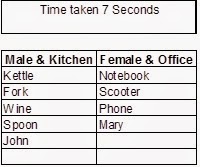
The mind’s data processing has just been introduced to a conflict. Historical data calls John male. But most Johns had never been seen in the kitchen. And so the mind needs to THINK and rationalize. I took 7 seconds to complete this test and this is how my results look like.

These two tests are variations of the Implicit Association Test. In simple terms it means, we have different kinds of biases based on information stored in our brain. These can be more than 100 types of biases. However the specific bias referred here is Stereo type bias, where the mind tends to make decisions based on the stereo type information fed into it.
However what does our experience with two tests tell us?
  1. Our perceptions are formed by the volume of information available to our brains over a period of time.
  2. Perceptions can be broken if we STOP the process of concluding results from the volume of information available. We CAN introduce new ideas to the brain and FORCE it THINK rationally.
Our brain can be forced to think differently fighting past information. It is up to us to enable our minds to think so. And before expecting others to think so, we need to do that ourselves.
A notable point here is that our own minds are susceptible to fall prey to implicit biases. For example: when I took the first test, in spite of me being a working woman who goes to office, I grouped the word “kitchen” under female. WHY? My brain merely processed the massive volume of information fed into it by new channels and historical data. Now in the second test, I stopped myself from auto-grouping “Kettle” under “Female & Office” and FORCED myself to think why can’t a spoon be categorized under Male. Why not desk under female? That is when my mind started changing perceptions and tried to think RATINOALLY.
As woman I want others to view me as a forthright and independent minded person. YET- I realise I have implicit biases within myself. And I sometimes subject myself to fall prey to them. I need to change how I THINK about myself and only then can I change what others think of me. And thus I need to create my own reality and then enable others to see it.
So, what reality are you going to create for yourself today?
References: You can go take the IAT on the internet, read more about it here or refer to the book Blink

Monday, March 30, 2015

Can you manage perception to create your reality?


“Perception is reality-Unfortunately our perception is your reality”- said a client director to my sales leader recently in a business discussion.
In a business scenario, our clients hold the purse strings. We need to add value to him/her woo them, please them enough to be convinced to change their perceptions about our products, our business and our brand in order to be associated with us.
But in a personal scenario, do we still do the same? Every single day that we come to work we carry a personal brand. We need to add value to the people we talk to, colleagues, clients, partners, something to take away. If it is a person in higher management or a client, we woo them, sell our image and create our perception in way we want it to be.
In an ideal world, our perception of ourselves should be our reality. But it is not. Usually our reality becomes what others perceive of us irrespective of what we believe in. Ex: Say, I have been working out for 3 months and feel really fit and trim. But when I run into a colleague who says, “Hey long time, looks like you have gained some holiday weight!” AND… blooop… there goes my confidence down the drain.
IT should not.
But it does.
And then we spend time for damage repair and convincing ourselves that what the others thought of us was not real.
Strangely this necessity to want to be perfect to the world shows up differently in different genders. While women show a larger inclination towards being perfect in their looks and also in multitasking (balancing home and work), men seem to show a higher tendency towards being viewed confident and as someone who is in charge of situations.
It is partly true that physical appearance as such plays an important role in image perception. Malcolm Gladwell in this article particularly speaks of why tall men are perceived to be leaders and 58% of CEOs in Fortune 500 companies are taller than 6 feet.
Yet, judgment about appearance has larger impact on female self-esteem than male. Many social experiments have particularly proved that beauty in other women or praise for other women sparks an instant threat in a woman. This is partly genetic and partly deep-rooted in the way women have been perceived time immemorial.
Similarly, the man has been the Alpha provider in tribes right since we evolved from Apes. While the purpose of the female has been to nurture, the man has been to provide and protect. This is again as deep rooted as is the female insecurity for physical appearance.
But why is any of this relevant to personal branding or building our perception? Because in order to build a brand for the world it is important to build a brand for oneself. What we are, we believe becomes our second nature and our reality and thus our perception.
How can then, either gender deal with this insecurity from affecting how they view their own personal image?
Recognize: Awareness and acknowledgement is the first step to action. It is important to recognize that feeling judged for physical appearance is in the genes and second nature of women. It also is an important part of self- identity. This acceptance saves many women the trouble to disprove it, fight and to keep re-defining their image based on what other think. Ex: A few days ago a male friend suggested that my profile picture on facebook looked boring. Ideally I should not be bothered. I actually thought it was very pretty and professional picture in a saree. Neither am I young teenager to feel flustered the moment I am not judged fashionable enough. And also I am as such not very dressy girl. Yet, it bothered me. The fact that a younger woman’s picture was stated as an example bothered me somewhere deep down inside. WHAT bothered me was not the comment but the fact that I was jealous. After deeply pondering over this thought, I have come to acknowledge that this is my nature. I am supposed to feel threatened deep down inside and that it is OK. I do not have necessity to prove that I don’t care, neither do I have a necessity to compete. I feel judged and that is ok. Whew!
For men, acceptance that their female family members would take more than “five minutes” to get dressed even when it is a pointless occasion would help their relationship greatly. Accept, she feels judged. It is in her genes.
Acceptance of ourselves or our partner’s second nature enables us to understand what the person is capable of. And then one can start constructing the reality around it. While it is imperative that our perception to the world needs to be associated with our actions, our work and what we can do, it is more important for us to know who we are. To accept ourselves, love ourselves, preen over the mirror, take pride in our physical appearance whatever it may be, at every stage and age of life. 
Because when we love ourselves and perceive ourselves to be loveable- our perception becomes our and others’ reality.